You Are Getting Terrible Sleep Advice

I’m a sleep therapist and I think most advice on how to fix your sleep is terrible.
You’re lying in bed, tossing and turning, desperate for sleep. You’ve tried meditation, supplements, blue light blocking glasses, white noise, ASMR, essential oils. But trying so hard might actually be making your sleep problems worse.
One curious thing I’ve noticed is that the people most eager to give sleep advice are often the ones struggling with sleep the most. If you ask someone who sleeps well for their secrets, they usually shrug. They just lie down and drift off. No hacks, no techniques, no tricks. Good sleepers hardly think about sleep at all.
That gap tells you something important. Let me explain why effort is the enemy of sleep.
What is Insomnia, Really?
Most people picture insomnia as total sleeplessness, someone barely functioning after days without rest. But sleep deprivation and insomnia are different things.
Sleep deprivation is when you don’t get enough sleep because the opportunity isn’t there: a new baby, night shifts, illness, or just staying up too late by choice.
Insomnia is difficulty falling or staying asleep despite having plenty of opportunity. Insomniacs often go out of their way to create the perfect conditions for sleep. They invest in the latest sleeping gear and follow every sleep hygiene rule they can find. And sleep still doesn’t come.
That frustration, putting in all the effort and still lying awake, is actually the key to understanding how insomnia works.
The Problem With Trying to Sleep
Good sleepers don’t put in any effort to fall asleep. Insomniacs do. That’s the problem.
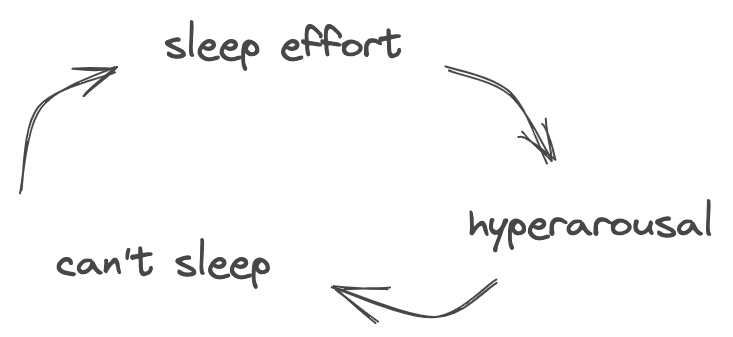
Your brain picks up on your behavior. When it sees you stressing about sleep, constantly trying to fix it, the fear center gets triggered. Sleep starts to look like a goal that requires extraordinary measures. It becomes a performance. If you mess up, you’ll pay for it the next morning.
Instead of relaxing, your brain thinks it needs to work. Your body shifts into hyperarousal, the exact opposite of sleep. Over time, this creates performance anxiety around bedtime. You worry about the harm that lack of sleep will cause, which pushes you to try even harder, which makes it worse.
This might sound like an oversimplification, but the principle is well-understood in behavioral sleep medicine. The vicious cycle of insomnia happens because you’re trying to control something that isn’t directly controllable. You teach your brain that being awake is dangerous, and that makes falling asleep even harder.
The Minimalist Approach to Fixing Sleep Problems
Sleep comes when you’ve been awake long enough. Like hunger or thirst, your sleep drive builds the longer you go without it. You don’t need to do anything special to fall asleep. You just need to stay awake.
To get back on track, stop trying to control your sleep and trust your natural sleep drive. I know that’s easier said than done. But your brain is a creature of habit. It learns from your actions, not your thoughts or feelings. If you act like sleep isn’t a big deal, your brain will eventually get the message.
The reverse is also true. If you treat sleep like a problem that needs solving, your brain will work overtime trying to “fix” it, right when it should be winding down.
Keep It Simple
Most sleep advice doesn’t work because it’s part of the problem. Every new technique, gadget, and hack teaches your brain that sleep is about performance. That you’ll only fall asleep if you get the conditions just right.
Your body can handle sleep on its own if you let it. Stay awake long enough and sleep will come. Here are two principles that will help you stay out of the way.
-
Stick to a consistent wake-up time, even on weekends. This is the single most effective thing you can do. Waking up at the same time every morning, no matter how poorly you slept, builds a strong sleep drive for the following night and aligns your circadian rhythm by getting you exposed to light early. If you’re going to do one thing to fix your sleep, this is it.
-
Go to bed when you’re sleepy. Keep your bedtime flexible and let your body decide when it’s ready. Only go to bed when you’re genuinely sleepy. If you can’t fall asleep, get up and do something enjoyable until you feel drowsy. When you act like not sleeping isn’t a big deal, your brain catches on and stops treating bedtime as a performance.
These two principles help retrain your brain to stop worrying about sleep and let the natural sleep drive do its job. Stop trying so hard, and you might find your body handles sleep fine on its own.